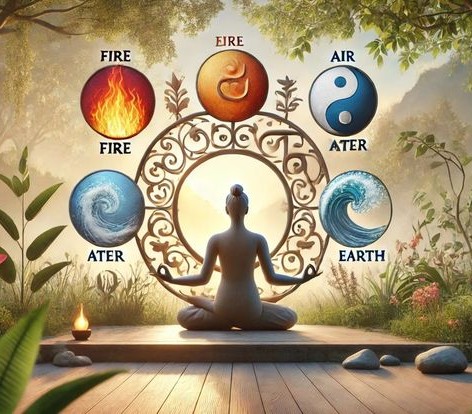
Pañcamahābhūta are the foundation of Ayurvedic anatomy, physiology, pathology, and treatment.
The aim of Ayurveda is to balance these elements for sustained physical, mental, and spiritual well-being.
Tejas dravya: These are hot, pungent, light, dry, minute, non-sticky and are attractive in form. Use of such ingredients increases burning, digestive power, metabolism, brightness or shine, enhances the complexion and lends a healthy glow to the body. They also cause an overall sensation of heat. Responsible for digestion, metabolism, body temperature, and intelligence.
Apya or jaliya dravya: These are liquid, cold, heavy, smooth, soft and moist. They lend moisture and softness to the body, increase determination and bring calmness and happiness to the mind and emotions Forms plasma, lymph, secretions, and maintains fluidity and cohesion.
Parthiva dravya: These are heavy, hard, tough, gross, solid, non-sticky and have an odor. These substances cause obesity with an increase in body weight and fat, and built muscles which provides strength and support. Forms bones, muscles, tissues, giving the body structure and strength.
After examining the properties and nature of these elements and the constitution of the human body, it is clear that the two elements – earth and water predominate in the body and its tissues. The solid part of the body (such as the muscles) is formed from the element earth, and the liquid part (such as the plasma) is formed from water. The empty spaces and cavities in the body relate mainly to the element of space (ether) and partially to that of air. Apart from this, various physical and mental processes are carried out with the help of the element of air. The food we ingest is metabolized and converted into rasa, rakta (blood), asthi (bone) and other dhātus by the element of fire.
The three doṣas (Vata, Pitta and Kapha) present in the body, the dhātus (rasa, rakta and other dhātus) constituting the body and the malas (waste products) are also formed by the combination of these five basic elements. In the same manner, different kinds of food materials and medicinal substances that nourish and treat our body are also constituted by these five elements.
To categorize food materials, elements are identified according to their rasa (taste), guna (attributes), vīrya (potency) and vipāka (post-digestive effect). It is sufficient to note that whenever there is an imbalance or disequilibrium in the body, a diet should be prescribed that will either increase or decrease the affected element to balance and restore harmony.